TL;DR
Startup SEO pricing summaries suggest a planning range of $1,000 to $5,000 per month, but scope matters more than the headline fee. Compare deliverables, implementation costs, and contract terms, then choose agency support, software, or a combination based on available staff.
A cheaper SEO retainer isn't cheaper if the startup still pays separately for writing, development, and reporting. SEO agency pricing for startups should reflect the total cost of getting useful work published, not just the amount on an agency invoice.
For founders and small marketing teams, the choice usually comes down to buying expert execution or managing a repeatable workflow internally. Earlyseo belongs in that evaluation when content-led SEO is part of the growth plan.
SEO agency pricing: The fees charged for search engine optimization services, usually through monthly retainers, defined projects, hourly consulting, or a combination.
The strongest proposal connects spending to business priorities: qualified leads, product discovery, local enquiries, or organic sales.
Table of Contents
How much does SEO agency pricing for startups cost?
SEO agency pricing for startups commonly falls between $1,000 and $5,000 per month in the supplied 2026 pricing summaries. That range is a planning reference, not an audited market average. Actual proposals depend on competition, website condition, content needs, and whether the agency implements recommendations or only supplies them.
Treat published ranges as context, not a quote
BizAI's September 2026 startup pricing summary gives the $1,000 to $5,000 monthly range. AgencyAnalytics' 2025 summary lists $1,500 to $3,000 monthly for small-business clients. Neither range establishes what a particular startup should spend.
A local service business with a few core pages needs a different scope from an e-commerce store with hundreds of products. A software startup entering a crowded category may need specialist writing and detailed comparison pages.
A useful budget starts with the work required to compete, then checks whether the startup can fund that work consistently.
Compare the four common payment models
| Pricing model | Suitable use | Contract detail to confirm |
|---|---|---|
| Monthly retainer | Ongoing content, technical work, and reporting | Monthly outputs and implementation ownership |
| Fixed project | Audit, migration review, or defined page improvements | Acceptance criteria and revision limits |
| Hourly consulting | Specialist advice with internal execution | Rate, estimated hours, and spending cap |
| Hybrid arrangement | Initial setup followed by ongoing support | Separation of setup and recurring fees |
A project can establish priorities before a retainer begins. Hourly advice fits teams that already have writers and developers. Retainers make more sense when the agency owns a continuing production schedule.
What should a startup SEO package include?
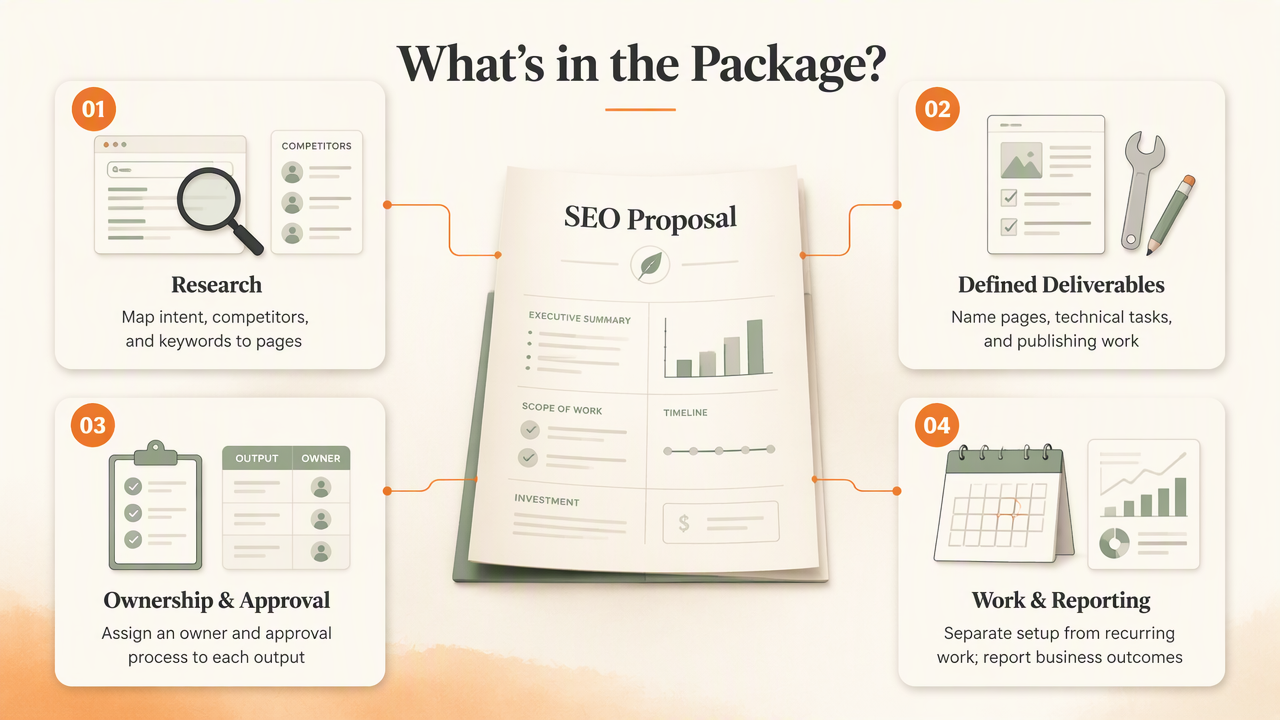
A startup SEO package should include a prioritized plan, clearly defined deliverables, implementation responsibilities, and reporting tied to business outcomes. The proposal should distinguish research from execution and recurring work from setup tasks. Content quantities alone aren't enough; each output needs a purpose, an owner, and an approval process.

Make the scope specific enough to verify
A promise to improve rankings leaves too much room for interpretation. Useful proposals identify the pages, technical tasks, and publishing work covered by the fee.
- Research: Search intent, competitor review, and keyword-to-page mapping.
- Technical work: Crawl findings, indexing checks, and prioritized fixes.
- Content: Briefs, writing, editing, page updates, and approval rounds.
- Publishing: CMS uploads, internal links, and metadata ownership.
- Measurement: Google Search Console reporting and conversion tracking where configured.
The agency SEO content playbook offers a relevant reference for organizing content work. The buying decision should still rest on the actual contract, not a general service description.
Separate deliverable fees from extra costs
Per-deliverable quotes are easiest to compare when the unit is precise: one edited article, one page rewrite, or one technical audit with an agreed page limit. An audit with implementation support isn't equivalent to a findings document alone.
Potential extras include developer time, specialist review, translation, design, and analytics setup. Local businesses should clarify responsibility for Google Business Profile work; online stores should confirm whether product and category templates are included.
International expansion adds another scope decision. A multilingual SEO content workflow should be evaluated alongside language review and market-specific research, rather than treated as simple word-for-word translation.
How should startups compare SEO proposals?
- Compare SEO proposals against the same business goal and website scope.
- Separate setup fees from recurring charges and optional extras.
- Assign writing, development, approval, and publishing responsibilities.
- Calculate the full commitment, including internal work.
- Set review dates using delivery milestones and qualified traffic or conversion signals.

Build a budget around the full commitment
Consider an illustrative proposal with a $2,000 monthly retainer and a $1,000 setup fee. A three-month initial engagement costs $7,000 before internal labor or separately billed work. Those figures are example arithmetic, not market benchmarks.
That calculation helps distinguish an affordable monthly invoice from an affordable engagement. Procurement should also check cancellation notice, renewal terms, and ownership of content and accounts.
A startup deciding between immediate demand capture and longer-term organic growth can use this SEO versus paid ads comparison. SEO shouldn't consume funding needed for essential product or sales operations.
Match the provider to the execution gap
The right provider fills the capability the startup lacks. A strong writer doesn't automatically solve technical indexing issues; a technical consultant doesn't automatically supply convincing product content.
- Founder-led startup: Favor a narrow scope with clear handoffs and limited meeting overhead.
- Growing marketing team: Buy specialist expertise while retaining strategy and approvals internally.
- Local business: Prioritize local visibility, service pages, and enquiry measurement.
- E-commerce store: Assess template work, category content, and developer availability.
This startup agency selection guide supports the broader fit assessment. Relevant experience should be judged by comparable work, not logos alone.
Check promises before signing
Guaranteed rankings, unexplained link packages, and vague deliverables deserve scrutiny. Proposal reviews should ask how links are earned, what happens when priorities change, and whether the startup retains account access.
Compare accountable work and total cost, not the largest keyword list or the boldest traffic promise.
How Earlyseo handles the content-workflow decision
Earlyseo offers a relevant option for startups evaluating software-supported SEO content work alongside agency services. Its published feature pages cover content and operations workflows, giving buyers concrete areas to assess during a product evaluation. The choice should follow the startup's staffing model and publishing needs.
Who should pick software, an agency, or both?
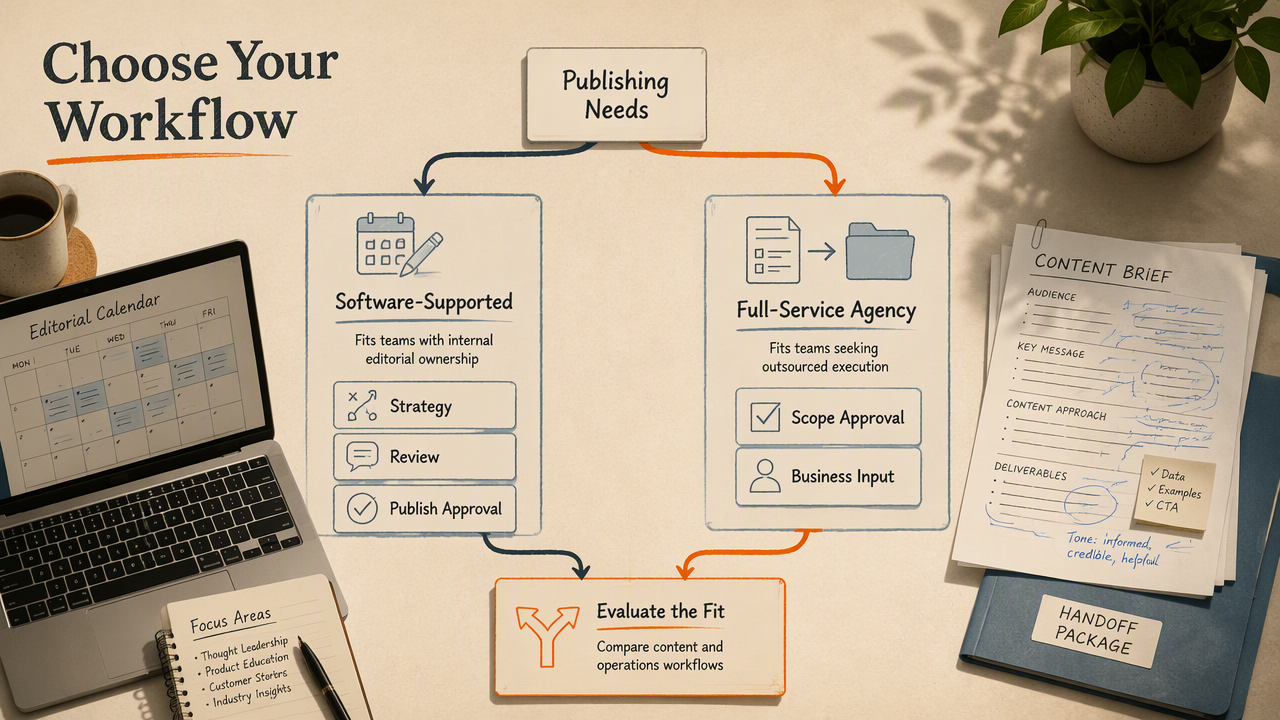
| Approach | Strongest fit | Responsibility to assign |
|---|---|---|
| Software-supported workflow | Teams with internal editorial ownership | Strategy, review, and publication approval |
| Full-service agency | Teams seeking outsourced execution | Scope approval and business input |
| Hybrid model | Teams combining internal production with specialists | Clear boundaries between each contributor |
For an internally managed approach, the SEO operations feature page provides a useful evaluation starting point. Teams can review workflow details on earlyseo.com and test how those details fit an existing content process.
Budget for AI-assisted work in 2027
AI-assisted marketing makes workflow ownership worth watching as agencies revise their services. Grewal, Satornino, and Davenport's 2024 research on generative AI and marketing examines that broader topic; it doesn't establish startup SEO prices.
Future proposals should explain who validates product claims, reviews content, and measures results. Those responsibilities remain useful buying criteria regardless of the tools involved.
- Ask which tasks use automation.
- Confirm human review responsibilities.
- Request separate pricing for added services.
Startup SEO pricing FAQ
Startup SEO buying decisions become clearer when contract scope, measurement, and ownership are settled before work starts.
Is a low-cost SEO package suitable for a startup?
A low-cost package can suit a startup when it covers a narrow, useful task and states exactly what gets delivered. A limited page refresh or advisory engagement is different from full-service SEO. The key test is whether the agreed work addresses a real priority without leaving essential implementation unassigned.
Should a startup choose an audit or a monthly retainer?
An audit suits a startup that needs diagnosis and has people available to implement findings. A retainer suits continuing work such as publishing, technical maintenance, and reporting. Buying an audit first can clarify scope, but the contract should explain how recommendations become completed tasks rather than an unused document.
How can a startup measure whether SEO spending is worthwhile?
A startup can assess SEO spending through completed work, relevant organic visits, and tracked business outcomes. Reporting should distinguish branded searches from discovery searches where practical. Leads, purchases, or qualified enquiries matter more than traffic alone, while attribution limits should be documented rather than hidden behind a single return figure.
Can SEO software replace an agency?
SEO software can support work that an internal team is prepared to own, but the buying decision depends on the task. Strategy, technical implementation, editorial review, and publishing still need assigned responsibility. A hybrid arrangement can combine software-supported production with specialist consulting when those roles are clearly separated.
Conclusion
SEO agency pricing for startups is most useful when attached to a specific execution plan. Before signing, the founder or marketing lead should request an itemized scope, calculate the initial commitment, and name the owner of every deliverable. For content-led work, compare an agency proposal with the Earlyseo platform using the same publishing goals and approval requirements.